Thin Vinyl vs. Thick Vinyl: Why Some Shirts Feel Like Shirts and Others Feel Like Plastic
One of the biggest differences between a shirt that feels homemade and one that feels professionally printed has nothing to do with the design.
It’s the feel of the vinyl on the shirt.
You can have a great design, perfect placement, and a clean press, but if the vinyl is thick and stiff, you’re still going to notice it every time you wear the shirt.
And once you notice it, you really notice it.
Some vinyl feels like it becomes part of the shirt.
Other vinyl feels like somebody glued a piece of plastic to the front of it.
That difference is usually described as the hand of the print.
What Does “Soft-Hand” Mean?
“Soft-hand” is basically industry language for how soft and natural a decoration feels on the fabric.
A soft-hand design doesn’t feel like a heavy layer sitting on top of the shirt.
Instead, the shirt still bends, folds, stretches, and moves pretty naturally.
Run your hand across it and you may still feel the design, but it isn’t especially thick or rigid.
That’s what I usually want.
Especially on a regular T-shirt.
If I’m wearing something soft and lightweight, I don’t want a giant stiff rectangle on the front of it.
Thin Vinyl Feels More Like the Shirt
Thin heat-transfer vinyl generally gives you a much more natural result.
The design still sits on top of the fabric, but there’s less material between you and the shirt.
That means the fabric stays more flexible.
It drapes better.
It moves better.
And when you grab the shirt, it still mostly feels like a T-shirt.
That becomes even more noticeable on large designs.
A tiny chest logo made from thicker vinyl may not bother you at all.
But take that same vinyl and cover most of the front of a shirt with it?
Now you can really feel it.
The larger the design gets, the more important the thickness of your material becomes.
Thick Vinyl Can Start Feeling Like a Plastic Panel
This is where some shirts go wrong.
Thicker vinyl can look perfectly fine, but physically it creates more of a barrier on top of the fabric.
If the design is large enough, the front of the shirt may not bend the same way anymore.
Instead of the fabric folding naturally, the vinyl starts controlling how that area moves.
That’s when you get the “shirt covered in plastic” feeling.
You’ve probably worn one before.
The front feels heavier.
The design feels stiff.
Sometimes the shirt even feels warmer because that big solid section doesn’t breathe the same way as the fabric around it.
It doesn’t necessarily mean the vinyl is bad.
It just means it may not be the right vinyl for that particular design.
Design Size Matters Almost as Much as Vinyl Thickness
This is important.
A thick vinyl used for a small logo can be completely fine.
A thin vinyl used for a giant solid block can still feel noticeable.
What really matters is the combination of:
- vinyl thickness
- total design area
- how much solid vinyl is in the artwork
- the type of shirt
- how flexible the vinyl is
A large design with lots of empty space will usually feel better than one giant solid shape.
That’s one reason good shirt designs often use negative space.
Besides looking better, you’re literally putting less material on the shirt.
Less material usually means a softer feel.
This Is Why Big Solid Backgrounds Can Be a Problem
Imagine two shirt designs that are both 10 inches wide.
One is mostly lettering with open space between everything.
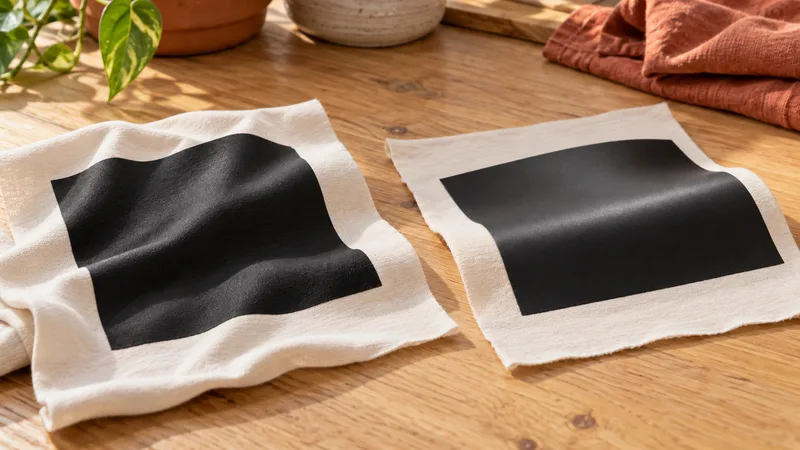
The other is a giant solid rectangle with lettering cut into it.
Those may be the same overall size, but they are going to feel completely different when you wear them.
The first design only puts vinyl where it actually needs it.
The second one basically creates a vinyl sheet across your chest.
That’s a huge difference.
If you want a softer-feeling shirt, one of the easiest things you can do is avoid unnecessary solid areas in the artwork.
Let the shirt itself become part of the design.
Softer Usually Feels More Professional
This is subjective, but I think thinner, softer vinyl generally makes a shirt feel more finished.
Especially for everyday shirts.
You want someone to put it on and basically forget the design is there.
That’s the goal.
The decoration should look good without constantly reminding you that you are wearing decoration.
When I think of a shirt that feels really good, the print moves with the fabric instead of fighting against it.
That’s soft-hand.
Thin Doesn’t Automatically Mean Better
There is one important catch.
Thin vinyl isn’t automatically better just because it’s thin.
Some specialty materials need more thickness.
Glitter vinyl is going to feel different.
Flock is supposed to have texture.
Reflective material has its own construction.
Some stretch vinyls are extremely thin but are designed for very specific fabrics.
And a super-thin material that doesn’t hold up in the wash isn’t doing you any favors either.
So I wouldn’t shop based on thickness alone.
I’d look for the combination of thin, flexible, durable, and appropriate for the fabric you’re pressing.
Your Pressing Matters Too
Even great vinyl can feel bad if it isn’t applied correctly.
Too much heat, too much pressure, repeated pressing, or layering several colors on top of each other can all affect the final feel.
Layering is a big one.
If you stack three or four layers of vinyl directly on top of each other, you’re obviously creating a thicker section.
Whenever possible, I like designs that minimize unnecessary stacking.
Again, the goal is to use as little material as you need to get the look you want.
Think About the Shirt You’re Actually Making
If you’re making a novelty shirt that somebody is wearing once, feel may not matter much.
If you’re making a shirt you’re hoping somebody wears every week, it matters a lot.
That’s the difference I think people sometimes miss.
We spend so much time thinking about whether a design looks good that we forget somebody eventually has to wear the thing.
The best shirt isn’t just the one that looks good sitting flat on a table.
It’s the one that still feels like a shirt when you put it on.
And in general, the thinner and more flexible you can keep the decoration while still getting the durability and appearance you need, the better that shirt is going to feel.
That’s really what people mean when they talk about a soft-hand print.
Less plastic.
More T-shirt.